
Employment and unemployment
Employment
The Labour Force Survey (LFS) defines an employed person as anyone aged 16, or over, who has completed at least one hour of work in the period being measured, or are temporarily away from his or her job, such as being on holiday. The number of people in employment is not the same as the number of jobs given that some people have more than one job.
Video courtesy of OECD
Categories of employment
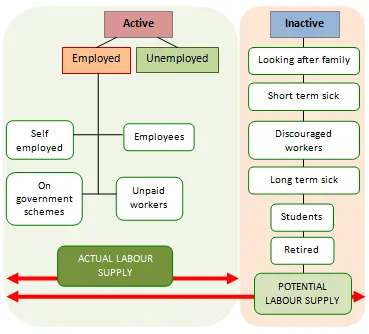
The LFS uses four categories of employment in the UK, which are:
- Employees
- The self-employed
- Unpaid family workers
- Participants in government-funded training schemes
The employment rate
The LFS defines the working age employment rate as the proportion of the working-age population who are in employment. The working age population includes men aged 16-64 and women aged 16-59.
Recent employment trends
With the onset of the global recession in 2008 (the ‘Great Recession’), the employment rate fell, and continued falling during 2009, to reach a low point of 70.1 by the end of 2011. Economic growth from 2012 onwards increased the employment rate, reaching a record level of 76.1% in July 2019.
Structural change
The trend towards increased employment in the service sector relative to the manufacturing and primary sectors has continued as the pace of globalisation has accelerated. Between 2000 and 2018, the numbers employed in manufacturing fell from 6.87m to 5.95m (from 24.6% of all jobs to 18.22%), while the numbers employed in services rose, from 20.63m to 26.35m (an increase from 74% to 81%).
Unemployment
The International Labour Organisation (ILO) definition of unemployment is those aged 16 or over are unemployed if they are:
- Out of work, want a job, have actively sought work in the last four weeks and are available to start work in the next two weeks.
- Out of work, have found a job and are waiting to start it in the next two weeks.
The unemployment rate
The ILO defines the unemployment rate as the proportion of the economically active people who are unemployed. The economically active are those who are either in employment or unemployed. (Source: ILO)
Full employment
The full employment of labour has been a key economic objective ever since the mass unemployment experienced in the 1930s. Clearly, it is not possible to give a simple numerical definition of full employment, other than to say the unemployment rate should be as low as is achievable, and the employment rate as high as is achievable.
In 2008, the UK Department for Work and Pensions (DWP) set the long-term target rate for working age employment of 80%.
Go to: Unemployment