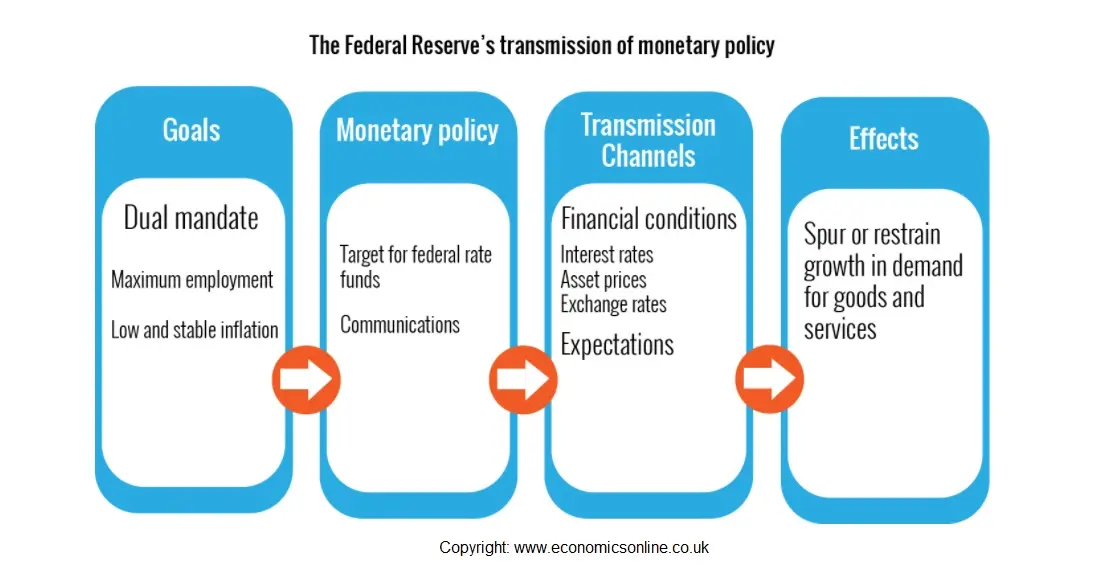
Monetary policy
Modern monetary policy has been shaped by the different schools of economic theory that emerged over the past 100 years. Monetary policy involves altering interest rates or the supply of money in the economy. Many economists consider that the manipulation of exchange rates is a form of monetary policy, given that exchange rates are affected by changes in interest rates.
The Monetary Policy Committee.
Monetary policy in the UK is the responsibility of the Bank of England’s Monetary Policy Committee (MPC). The MPC has nine members, four of whom are appointed by the Chancellor. The MPC has one goal, to hit its inflation target of 2%.
The inflation target is symmetrical, meaning that a rate of inflation below the target is considered as problematic as a rate of inflation above the target.

Changing official base interest rates is the most visible tool used by the MPC, whose team of economists meet each month to discuss current and future monetary policy options.
The Repo rate
Repo is short for repurchase agreement, and the
repo rate is the rate at which the Bank of England buys back
securities it has previously sold in the money markets. The money
markets include banks, building societies and specialist securities
dealers. Altering the repo rate affects short-term liquidity in the
monetary system, which quickly has an effect on all other rates.
Other rates of interest in the economy, such as mortgage rates, will adjust in line with changes to the official rate.
Why the inflation target is not zero
According to the Bank of England, there are two reasons why the inflation target is set above zero:
Real interest rates can become negative
A positive rate allows real interest rates to become negative at times of weak demand. Real interest rates are nominal rates, less the inflation rate. Nominal interest rates can never be negative, as banks will always charge for lending. If inflation is 0%, nominal and real interest rates must be the same, hence, like nominal rates, real rates cannot be negative. It may be helpful for the Bank of England to make real interest rate negative at times of a deep recession, so having a positive inflation target allows this to happen.
Safety margin
Inflation cannot be measured with perfect precision, and it is safer to have a positive inflation target as this provides a margin of safety.
How does interest-rate policy work?
Interest rates are set so that the inflation target can be met in the future. In fact, it takes up to two years for a rate change to affect inflation, so the Bank of England must try to predict the state of the economy two years in advance!
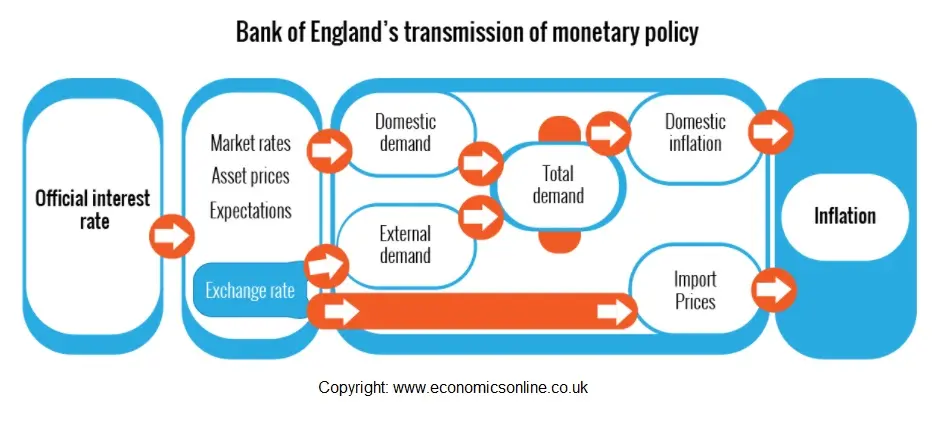
Interest rates transmit their way to aggregate demand in the following ways:
-
Changes in the official rate affect all markets rates, such as overdraft, mortgage, and credit card rates. Consumer demand is affected in a number of ways including affecting savings, which indirectly affect spending, and spending itself. For households or firms with existing debt, such as a mortgage, a change in rates affect repayments, and hence individuals have more (or less) cash after servicing their debts. Changes in rates affect the cash-flow firms and households.
-
In the case of new debt to fund spending, borrowing is also encouraged, or discouraged, following interest rate changes. Interest rates also affect consumer and business confidence, and spending.
-
Asset prices are also affected by interest rates. For example, a fall in rates will tend to make firms more profitable and they may pay higher dividends to shareholders, which can trigger an increase in spending. Similarly, a rate fall makes property more attractive, increasing the value of property and household wealth.
-
Changes in the official rate also affect general expectations and confidence, which alters consumer and corporate behaviour. For example, a rise in rates indicates a tighter monetary stance and has a negative impact on consumer and corporate sentiment, leading to the postponement of discretionary spending.
-
Finally, interest rates may affect the exchange rate, which can also influence export demand. For example, a rise in interest rates may raise the exchange rate, pushing up export prices and reducing overseas demand. Changes in the exchange rate also affect the price of imports, which also affect the inflation rate, through its effect on imported costs. For example, a fall in the exchange rate increases import prices and creates cost-push inflation. In this case, a rise in interest rates will push up the exchange rate and ease any cost-push inflationary pressures.
Summary of the transmission mechanism of monetary policy

Video
Recent UK interest rates
In recent years, interest rates have been frequently adjusted to reflect changing macro-economic conditions.
1999 – 2000
Rates were relatively high at 6% to restrict demand.
2000 – 2003
Rates fell quickly to their lowest level for 25 years, helping to stimulate demand.
2003-2007
Rates were pushed up into a neutral zone at around 5%, but by 2007 they were edging up towards the restrictive zone.
2008 -2012
In response to the deepening recession, rates were slashed to levels unprecedented in modern times.
The effect of a reduction in interest rates
If we assume the economy has an output gap then a reduction in interest rates by the Bank of England will, ceteris paribus, increase aggregate demand.
A reduction in interest rates will stimulate aggregate demand. This creates a positive effect on economic growth, but at the potential cost of inflationary pressure.

The increase in aggregate demand occurs for seveal reasons, including:
-
Falling savings
-
More new borrowing
-
Lower costs of servicing existing debts
-
Rising confidence
-
Greater export demand
-
Rising asset values
-
Rising business investment
Pushing rates too low is inflationary
Assuming the economy is at or very near to full employment, a reduction in interest rates by the Bank of England may over-stimulate aggregate demand beyond the capacity of the economy to respond in the short run.
In this case, the effect is mainly on the price level rather than output and jobs.
Therefore, interest rates can be used to help stabilise the macro-economy, and help create stable growth and stable prices. Policy induced shocks need to be avoided, so changes in interest rates tend to be small – usually 0.25% at a time. However, the depth of the recession in 2008, and its speed of onset, forced the Bank of England to reduce rates more quickly than in 'normal' economic times.
The advantages of interest rate policy
Powerful and direct
Evidence shows that interest rates have a
direct and powerful effect on household spending, the evidence
suggesting that UK consumers are interest rate elastic.
Independent
The Bank of England’s Monetary Policy
Committee is independent of government and can make decisions free
from political interference.
Easy to implement
Interest rates can be changed on a monthly
basis, which contrasts with changes in discretionary fiscal policy, which cannot
be made at such regular intervals.
Quick effect on confidence
While the full effects of interest changes
may not be experienced for up to two years, there is often an immediate
effect on confidence. The time lag affecting output is estimated to be around
one year, and on the price level, around two years.
The advantages of interest rate policy
There are still time lags to see the full
effects, and there are some other negative effects, including:
Investment can suffer
Investment spending is inversely related to
interest rates, and higher rates increase the opportunity cost of
investment. Long term, economic growth will suffer if high interest
rates persist.
The housing market can suffer
The housing market is very sensitive to
changes in interest rates, so individual changes tend to be small,
partly so as not to have an excessive effect on housing.
The dual economy
There is also the problem of the dual economy.
Should rates be set high to control the inflating service sector, or low
rates for the depressed manufacturing and export sector? Unlike previous
recessions, in the current recession all sectors of the economy have
been suffering in a similar way, so rates have been set at historically
low levels without any fear of inflation.
The liquidity trap
Reducing interest rates in a recession may be ineffective because of the so-called liquidity trap. This theory is associated with Keynes, and his analysis of the Great Depression. In a recession interest rates will fall towards zero, as in the UK during 2009, following the financial crisis. In this case, banks and other financial intermediaries prefer to hold cash rather than make loans. Therefore, while borrowing may be stimulated, liquidity is not released through the system - it is 'trapped' and unavailable. This acts to deepen a recession and weaken the real economy. In this case, authorities may have to by-pass the banks and pump money directly into the public's hands. Allocating spending vouchers is one way this could be achieved. This is often referred to a 'helicopter' or 'parachute' money. More formally, the process is called quantitative easing.
Quantitative easing is a process whereby the Bank of England, under instructions from the Treasury, buys up existing bonds in order to add money directly into the financial system. The process of doing this is called open market operations, and it is regarded as a last resort when low interest rates fail to work.
When interest rates approach zero, but an economy remains in recession, further interest cuts are impossible. This situation faced central bankers in early 2009. Interest rate policy in these circumstances becomes impotent, as nominal interest rates cannot fall below zero. This, together with cash hoarding by individuals, corporations and commercial banks, resulted in liquidity being trapped in the banking system. In this situation quantitative easing may be necessary to boost liquidity and stimulate lending.
Quantitative easing involves the following
steps:
-
The Bank of England purchases existing corporate and government bonds held by banks and corporations with electronic money, rather than notes and coins.
-
These funds are credited to the bank and become a reserve asset.
-
This means that, via the credit multiplier, banks can lend out to corporate and individual customers.
-
The hope is that lending starts to flow, which will lead to an increase in household and corporate spending, and aggregate demand. This, it is argued, will help pull an economy out of recession.
The European Central Bank (ECB)
The ECB meets on a monthly basis to determine two things:
-
The level of interest rates across the euro area - the 17 countries that share the euro
-
The quantity of money in circulation
The primary purpose of the ECB is to control euro area inflation so that the value of the euro remains constant and strong. It also provides liquidity into the system when needed. If an EU country joins the euro area, its central bank cedes most of its power to the ECB.
EU monetary institutions are fundamentally anti-fiscal, and greatly influenced by the monetarist view. Europe’s view can be summarised as:
-
Fiscal policy is less useful than monetary policy to help stabilise the macro-economy.
-
Too much borrowing will harm the stability of the Euro, hence the Stability Pact.
-
Fiscal policy is less useful than supply-side policy to help create long-term growth.
Asymmetric inflation target
Unlike the Bank of England's inflation target, which is symmetrical, the ECB target is asymmetrical. This means that while inflation cannot rise above 2%, there is no figure which it is must not fall below. Critics argue that this creates an in-built recessionary bias, with no specific policy intervention required if deflation occurs. In the UK, the target is 2% +/- 1, so that an inflation rate of less than 1% triggers a monetary stimulus.
Euro area interest rates
Euro area interest rates have been fairly stable since 2000, with rates averaging around 2%.
Even before the financial crisis, the one-size-fits-all approach had been running into difficulty. This was largely because of increasing differences in the performance of the various euro area countries, including differences in growth rates, fiscal deficits, trade balances, and house prices.
The poor macro-economic performance of the Euro area
In recent years growth rates in the EU have lagged behind those of the USA and the UK.
The poor growth record of the euro area may be down to the inflexible economies of its member countries, rather than monetary policy. In other words, the underlying problems of Europe are more to do with poor supply-side performance than ineffective demand-side policy. The ECB itself recognises that growth problems are more down to national governments failing to come to terms with globalisation, that with ineffective monetary policy.
In addition, the ECB has been generally reluctant to reduce interest rates to deal with sluggish growth, mainly due to fears about raising inflationary expectations. However, the financial crisis of 2008-09 has forced the ECB to reduce interest rates to a historically low level, at 1.5%. Despite this, the Euro area is likely to continue to suffer from a deep recession which, by late 2009, was running at (-) 4%.
Critics argue that, unless the economy is flexible, a fiscal or monetary stimulus to help the financial crisis may simply drive up prices.
In addition, a fiscal stimulus could also lead to balance of payments problems, and if funded by borrowing, could crowd-out the private sector.
The Stability Pact was established to provides a
constraint against a fiscal stimulus, although the depth of the
financial
crisis has caused debt levels to rise well above those set down in
the pact. The ongoing sovereign debt crisis has put the whole
Euro-system at risk as it battles to form a fiscal union which would
give power to the EU itself to control national budgets.