Economic integration
Economic integration
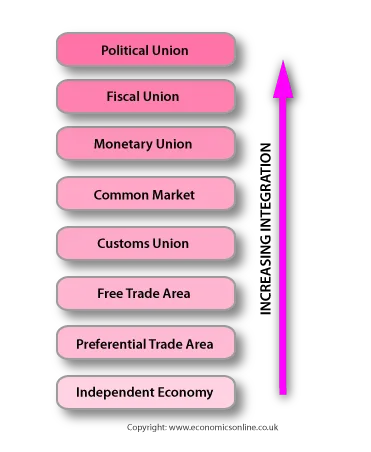
There are several stages in the process of economic integration, from a very loose association of countries in a preferential trade area, to complete economic integration, where the economies of member countries are completely integrated.
A regional trading bloc is a group of countries within a geographical region that protect themselves from imports from non-members in other geographical regions, and who look to trade more freely with each other. Regional trading blocs increasingly shape the pattern of world trade – a phenomenon often referred to as regionalism.
Stages of integration
Preferential Trade Area
Preferential Trade Areas (PTAs) exist when countries within a geographical region agree to reduce or eliminate tariff barriers on selected goods imported from other members of the area. This is often the first small step towards the creation of a trading bloc. Agreements may be made between two countries (bi-lateral), or several countries (multi-lateral).
Free Trade Area
Free Trade Areas (FTAs) are created when two or more countries in a region agree to reduce or eliminate barriers to trade on all goods coming from other members. The North Atlantic Free Trade Agreement (NAFTA) is an example of such a free trade area, and includes the USA, Canada, and Mexico.
Customs Union
A customs union involves the removal of tariff barriers between members, together with the acceptance of a common (unified) external tariff against non-members.
Countries that export to the customs union only need to make a single payment (duty), once the goods have passed through the border. Once inside the union goods can move freely without additional tariffs. Tariff revenue is then shared between members, with the country that collects the duty retaining a small share.
The advantages of a customs union
Without a unified external tariff, trade flows would become distorted. If, for example, Germany imposes a 10% tariff on Japanese cars, while France imposes a 2% tariff, Japan would export its cars to French car dealers, and then sell them on to Germany, thereby avoiding 80% of the tariff. This is avoided if a common tariff is shared between Germany and France (and other members of the customs union.)
A common external tariff effectively removes the possibility of arbitrage and, some would argue, is one of the fundamental building blocks of economic integration.
The disadvantages of a customs union
Union members must negotiate collectively with non-members or organisations like the WTO as a single group of countries. While this is essential to maintain the customs union, it means that members are not free to negotiate individual trade deals.
For example, if a member wishes to protect a declining or infant industry it cannot do so through imposing its own tariffs. Equally, if it wishes to open up to complete free trade, it cannot do so if a common tariff exists.
Also, it makes little sense for a particular member to impose a tariff on the import of a good that is not produced at all within a that country.
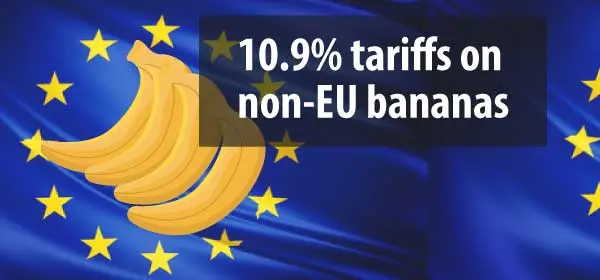 For example, the UK does not produce its own bananas, so a tariff on banana imports only raises price and does not protect domestic producers. The current EU tariff on bananas imported from outside the EU is 10.9%.
There is also a potential disadvantage to a single member in how the tariff revenue is allocated. Members that trade relatively more with countries outside the union, such as the UK, may not get their ‘fair share’ of tariff revenue.
The UK’s status as a customs union member is one of the dilemmas facing the UK as a result of Brexit. If it wishes to create individual trade deals with, say the USA and China, it cannot retain its current status as a full member of the customs union.
Common Market
A common (or single) market is the most significant step towards full economic integration. In the case of Europe, the single market is officially referred to a the ‘internal market’.
The key feature of a common market is the extension of free trade from just tangible goods, to include all economic resources. This means that all barriers are eliminated to allow the free movement of goods, services, capital, and labour.
In addition, as well as removing tariffs, non-tariff barriers are also reduced and eliminated.
For a common market to be successful there must also be a significant level of harmonisation of micro-economic policies, and common rules regarding product standards, monopoly power and other anti-competitive practices. There may also be common policies affecting key industries, such as the Common Agricultural Policy (CAP) and Common Fisheries Policy (CFP).
Economic union
Economic union is a term applied to a trading bloc that has both a common market between members, and a common trade policy towards non-members, although members are free to pursue independent macro-economic policies.
The European Union (EU) is the best known Economic union, and came into force on November 1st 1993, following the signing of the Maastricht Treaty (formally called the Treaty on European Union.)
Monetary Union
Monetary union is the first major step towards macro-economic integration, and enables economies to converge even more closely. Monetary union involves scrapping individual currencies, and adopting a single, shared currency, such as the Euro for the Euro-17 countries, and the East Caribbean Dollar for 11 islands in the East Caribbean. This means that there is a common exchange rate, a common monetary policy, including interest rates and the regulation of the quantity of money, and a single central bank, such as the European Central Bank or the East Caribbean Central Bank.
Fiscal Union
A fiscal union is an agreement to harmonise tax rates, to establish common levels of public sector spending and borrowing, and jointly agree national budget deficits or surpluses. The majority of EU states agreed a fiscal compact in early 2012, which is a less binding version of a full fiscal union.
Economic and Monetary Union
Economic and Monetary Union (EMU) is a key stage towards compete integration, and involves a single economic market, a common trade policy, a single currency and a common monetary policy.
Complete Economic Integration
Complete economic integration involves a single economic market, a common trade policy, a single currency, a common monetary policy, together with a single fiscal policy, including common tax and benefit rates – in short, complete harmonisation of all policies, rates, and economic trade rules.
See also: