The Economic Problem
All societies face the economic problem, which is the problem of how to make the best use of limited, or scarce, resources. The economic problem exists because, although the needs and wants of people are endless, the resources available to satisfy needs and wants are limited.
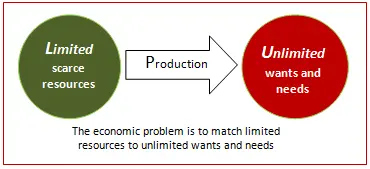
Limited resources
Resources are limited in two essential ways:
- Limited in physical quantity, as in the case of land, which has a finite quantity.
- Limited in use, as in the case of labour and machinery, which can only be used for one purpose at any one time.
Choice and opportunity cost
Choice and opportunity cost are two fundamental concepts in economics. Given that resources are limited, producers and consumers have to make choices between competing alternatives. Individuals must choose how best to use their skill and effort, firms must choose how best to use their workers and machinery, and governments must choose how best to use taxpayer’s money.
Making an economic choice creates a sacrifice because alternatives must be given up. Making a choice results in the loss of benefit that an alternative would have provided. For example, if an individual has £10 to spend, and if books are £10 each and downloaded music tracks are £1 each, buying a book means the loss of the benefit that would have been gained from the 10 downloaded tracks. Similarly, land and other resources, which have been used to build a school could have been used to build a factory. The loss of the next best option represents the real sacrifice and is referred to as opportunity cost. The opportunity cost of choosing the school is the loss of the factory, and what could have been produced.
It is necessary to appreciate that opportunity cost relates to the loss of the next best alternative, and not just any alternative. The true cost of any decision is always the closest option not chosen.
Samuelson’s three questions
America’s first Nobel Prize winner for economics, the late Paul Samuelson, is often credited with providing the first clear and simple explanation of the economic problem – namely, that in order to solve the economic problem societies must endeavour to answer three basic questions – What to produce? How to produce? And, For whom to produce?
What to produce?
Societies have to decide the best combination of goods and services to meet their varied wants and needs. Societies must decide what quantities of different resources should be allocated to these goods and services.
How to produce?
Societies also have to decide the best combination of factors to create the desired output of goods and services. For example, precisely how much land, labour, and capital should be used to produce consumer goods such as computers and motor cars?
For whom to produce?
Finally, all societies need to decide who will benefit from the output from its economic activity, and how much they will get. This is often called the problem of distribution.
Different societies may develop different ways to answer these questions.
Free goods
A free good is one that is so abundant that its consumption does not deny anyone else the benefit of consuming the good. In this case, there is no opportunity cost associated with consumption or production, and the good does not command a price. Air is often cited as a free good, as breathing it does not reduce the amount available to someone else.